

There is a paradox at the heart of African finance that deserves to be named plainly. The continent is generating some of the richest behavioural and transactional financial data on earth, produced daily by hundreds of millions of mobile money users, informal traders, smallholder farmers, and micro-entrepreneurs. And almost none of it is being used to extend them credit, price them insurance, or offer them the financial services their economic activity has already proven they deserve.This is not a failure. It is an opportunity so large, and so close, that the only honest response is urgency.
The Richest Poor Country in the World, in Data Terms
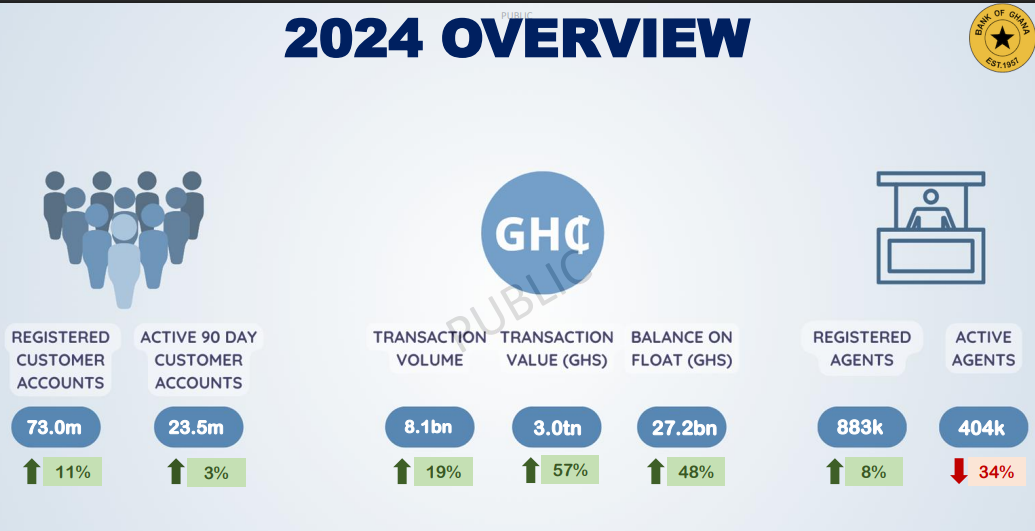
Ghana offers perhaps the clearest illustration of this paradox anywhere in the world. The country has built one of the most sophisticated mobile money ecosystems on earth. Transactions flow through GhIPSS at extraordinary volume. The Ghana Card is being integrated into financial infrastructure. The regulatory architecture is among the most coherent in the sub-region. And yet the majority of Ghanaians who use these systems daily, who have built documented financial histories through years of consistent transactions, remain invisible to the formal credit system.They are not credit risks. They are data orphans. Their financial behaviour exists, richly documented, in systems that were designed to process transactions rather than to understand the people making them.
The result is a paradox: vibrant economic activity coexists with restricted access to credit. The market trader whose mobile money record shows three years of consistent inflows and disciplined spending cannot access a working capital loan. The smallholder farmer whose airtime payment history reveals seasonal income patterns cannot obtain crop insurance at a fair price. The micro-entrepreneur whose transaction frequency rivals a small bank branch cannot get a business account with meaningful features. Not because they are unworthy. Because no one has yet built the bridge between the data that exists and the decisions that data could inform.That bridge is the defining financial infrastructure opportunity of the next decade.
The evidence from comparable markets is instructive and, frankly, astonishing.Egypt’s MNT-Halan has developed an AI-powered alternative credit scoring engine that uses behavioural and transactional data to evaluate users who have never interacted with formal credit systems. Through this model, the company automated more than 50 percent of its loan approvals and achieved a 60 percent approval rate for previously unscoreable users. These are not marginal improvements to an existing system. They represent a fundamental redefinition of who counts as creditworthy.In Ethiopia, AI-driven lending facilitated roughly $150 million in credit to more than 380,000 micro, small, and medium enterprises through uncollateralised facilities powered by alternative data scoring. Uncollateralised credit to nearly 400,000 enterprises, in a market that traditional finance had deemed unlendable, delivered not through charity or concessional finance, but through a better reading of data that already existed.
In Tanzania, an AI fintech startup built a platform that processed over 15,000 loan applications within six months of launch, cutting credit decision time from several hours to under two minutes, with loan default prediction accuracy approaching 91 percent.
The pattern across every one of these cases is identical. The data existed before the solution. The people were economically active before anyone decided to look at their activity as evidence of creditworthiness. What changed was not the behaviour of borrowers. What changed was the willingness and capability of institutions to read what was already written.Ghana has more transaction data per capita than most of these markets had when those solutions were built. The question is not whether the data exists. It is whether Ghana will choose to use it.
The Infrastructure That Makes Data Useful
Data without portability is not an asset. It is a archive. The distinction matters enormously for what comes next in Ghana.The Bank of Ghana has proposed establishing the Open Data Exchange platform, known as OpenDX, a dedicated public digital infrastructure designed to facilitate the safe and secure sharing of customer-consented data among participating institutions. This is not a minor technical initiative. If implemented with the urgency and rigour it deserves, OpenDX is the institutional mechanism that converts Ghana’s transaction history from a collection of individual silos into a shared national resource for financial innovation.
The global open banking market was valued at approximately $31.6 billion in 2024 and is projected to reach $135 billion by 2030, and within Africa the open banking ecosystem is expected to grow at a compound annual rate of around 18 percent through 2030 as more regulators and banks adopt interoperability frameworks. Ghana is not late to this transition. It is, by African standards, ahead of it. The draft directive exists. The proof-of-concept is underway. Some banks are already participating in pilot programmes.What separates proof-of-concept from transformative infrastructure is implementation discipline and institutional commitment. The countries that have moved from framework to functioning open banking system share one characteristic: they treated data portability not as a feature of the financial system but as the foundation of it. Ghana has the architecture. It now needs the resolve.
Three Things That Become Possible When Ghana Acts
The visionary case for data activation in Ghana is not abstract. It is specific, proximate, and grounded in what comparable markets have already demonstrated.
Credit becomes inclusive by design, not by exception. Today, credit in Ghana flows predominantly to those who already have formal financial histories, which is to say, those who need it least. When Ghana’s mobile money transaction data, utility payment records, and Ghana Card identity infrastructure are linked through a functioning open banking framework, a new class of borrower becomes visible. The market trader, the artisan, the smallholder farmer, the gig worker. AI-powered lending is increasing financial inclusion by expanding accessibility to credit via mobile apps, alternative data, and embedded finance, with fintechs becoming essential intermediaries for individuals, small family businesses, and SMEs to access finance by bridging the gap between financial institutions and users. Ghana has the raw material for precisely this transformation. The data infrastructure to activate it is within reach.
Insurance becomes affordable and relevant. Africa’s insurance penetration remains among the lowest in the world. The conventional explanation is affordability. The deeper explanation is product design. Insurance priced from population averages rather than individual behavioural data is both expensive and irrelevant to the person buying it. When transaction data, seasonal income patterns, and agricultural behaviour can be read in real time, insurers can price products that actually reflect individual risk. The smallholder farmer pays a premium calibrated to her specific crop, location, and financial history. The gig worker receives income protection priced to her actual earnings volatility. This is not a speculative future. It is already happening in Kenya and South Africa. The data infrastructure required to bring it to Ghana is the same infrastructure being built right now.
The informal economy becomes formally legible. Ghana’s informal economy is not ungoverned. It is undocumented. The distinction is critical. Informal traders follow patterns, build relationships, manage credit, and service obligations with remarkable consistency. They simply do so outside the systems that formal finance uses to see them. Open banking, combined with Ghana’s mobile money infrastructure and the Ghana Card, creates the conditions under which the informal economy begins to generate the kind of financial record that formal institutions can act upon. Open banking can allow banks and fintechs to use everyday data, such as mobile money transactions or utility bill payments, to offer financial services to people who do not have traditional bank histories. When that happens, Ghana’s informal economy does not become formal. It becomes visible. And visibility, in finance, is the prerequisite for everything else.
What Ghana Must Do Now
Three actions determine whether this opportunity is realised or deferred.
Operationalise OpenDX with published standards and a binding timeline. The draft Open Banking Directive is a credible foundation. What it requires now is conversion from policy document to functioning infrastructure. Published API standards, a clear accreditation process for third-party providers, and an implementation timeline that regulated institutions can build against. Ghana must first establish a solid open banking foundation, defining the legal and security frameworks for sharing customer financial data, identifying the right API standards, and ensuring that all participating institutions meet minimum cybersecurity requirements. Once that groundwork is done, innovation can thrive safely. The groundwork is close to done. The transition to live infrastructure is the next irreversible step.
Treat the Ghana Card as a credit infrastructure asset, not only an identity document. The Ghana Card is already the most significant financial inclusion intervention in the country’s recent history. Its integration into lending decisions via GhIPSS’s API development is underway. The institutional imperative is to complete this work at pace. Every Ghanaian with a Ghana Card and a mobile money history is, in principle, a scoreable borrower. The only thing standing between that principle and reality is the completion of the infrastructure that connects identity to transaction history to credit decision.
Build the regulatory framework for AI-driven credit decisioning. Ghana’s AI strategy identifies financial services as a key sector for AI adoption and promotes applications such as automated credit scoring and insurance claims processing, calling for public-private partnerships and pilot projects in collaboration with the Bank of Ghana to accelerate AI integration. That strategic intent must translate into a regulatory framework that gives lenders the confidence to use alternative data in credit decisions, protects consumers from algorithmic harm, and creates the standards of transparency and accountability that make AI-driven finance trustworthy. This is not a constraint on innovation. It is the condition that makes innovation sustainable.
The Continent Is Watching
Ghana does not operate in isolation. The choices it makes on data infrastructure will be observed, studied, and either replicated or avoided by every financial regulator in West Africa.
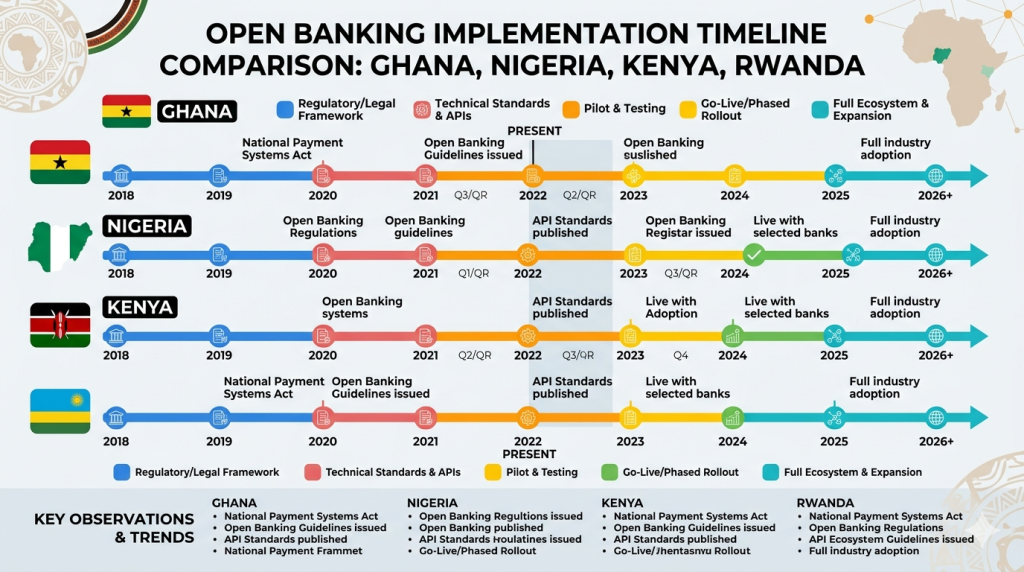
Nigeria is advancing open banking frameworks and has moved on tiered KYC. Kenya is building its data portability architecture. Rwanda launched its Centre for Digital Public Infrastructure earlier this year, explicitly positioning the country as a hub for open and scalable digital systems. Africa’s fintech platforms are no longer just adopting global technologies. They are beginning to export solutions that attract global investors. The continent is building its own playbook. Ghana has the opportunity to write a significant chapter of it.The countries that win the data infrastructure race will not simply have more efficient financial systems. They will have financial systems capable of seeing their entire economies, not just the formal portion. They will be able to extend credit to the entrepreneur who has earned it. Price insurance for the farmer who needs it. Build the savings products that the emerging middle class will actually use. Connect the informal economy to the formal one, not by forcing compliance, but by making visibility attractive.
That is what data activation makes possible. Not a better version of the financial system Ghana already has. A fundamentally different one, built on the truth of what Ghanaians are already doing with their money, rather than on the fiction that those who lack a credit bureau entry lack creditworthiness.Ghana’s most valuable financial asset is not its payment infrastructure, impressive as that is. It is not its regulatory architecture, rigorous as that has become. It is the accumulated financial behaviour of millions of people whose economic lives are richly documented and almost entirely ignored by the systems that could serve them.Activating that asset is the work of this decade. The institutions, the technology, and the regulatory intent are all present. What remains is the collective decision to treat data not as a byproduct of financial activity, but as its most powerful input.When Ghana makes that decision in full, and builds the infrastructure to match it, the question of financial depth will answer itself.